Quick Answer
tl;dr: Text back within a minute or two, name your business, admit you missed the call, and ask exactly one question. That’s the whole formula. The wording matters more than whether it’s automated or typed by hand; software is only worth adding once your call volume makes replying that fast by hand unrealistic.
If you only take one thing from this post: text back within a minute or two, name your business, admit you missed the call, and ask exactly one question.
Here’s the line I use as a starting point:
“Hi, this is [Business Name]. Sorry we missed you. What’s going on, and I’ll get right back to you.”
That’s it. No form, no menu, no “please hold.” Everything else in this post is about why that works and how to adapt it without it turning into something that reads like a bot wrote it.
Why Most Missed-Call Texts Sound Like a Robot Wrote Them
I’ve read a lot of these templates, and most of them have the same problem: they’re written to be filled in, not sent. You can spot them immediately: “Hi [First Name], thank you for contacting [Business Name]. We appreciate your interest and will respond within [X] business hours.” Nobody talks like that, and customers know it the second it hits their phone.
Three things make a text feel robotic:
- Too many words. A real person doesn’t open with three sentences of throat-clearing. They say what happened and ask one thing.
- No admission. If the text doesn’t acknowledge that a real call was missed by a real person, it reads like a form letter, not a reply.
- Too many questions at once. “What’s the issue, what’s your address, when are you available, and is this an emergency?” is an intake form, not a text message. People bail on it.
Fix those three things and the exact same automation (sent by software or typed by hand) reads like a person, not a system.
The 4-Part Structure That Actually Works
Every good missed-call text has four pieces, in this order:
- Name the business. So they know who’s texting before they read anything else.
- Acknowledge the miss. “Sorry we missed you” does more work than people give it credit for. It tells the customer you know they called and you’re not ignoring them.
- Ask one question. Not three. One. The single-question rule roughly doubles reply rates compared to an open-ended “how can we help.”
- Make replying effortless. No links to click, no forms to fill out. Just “text me back” and a short prompt.
That’s the whole formula. Everything past this is just tailoring it to your trade.
The Template
Base version (works for any trade):
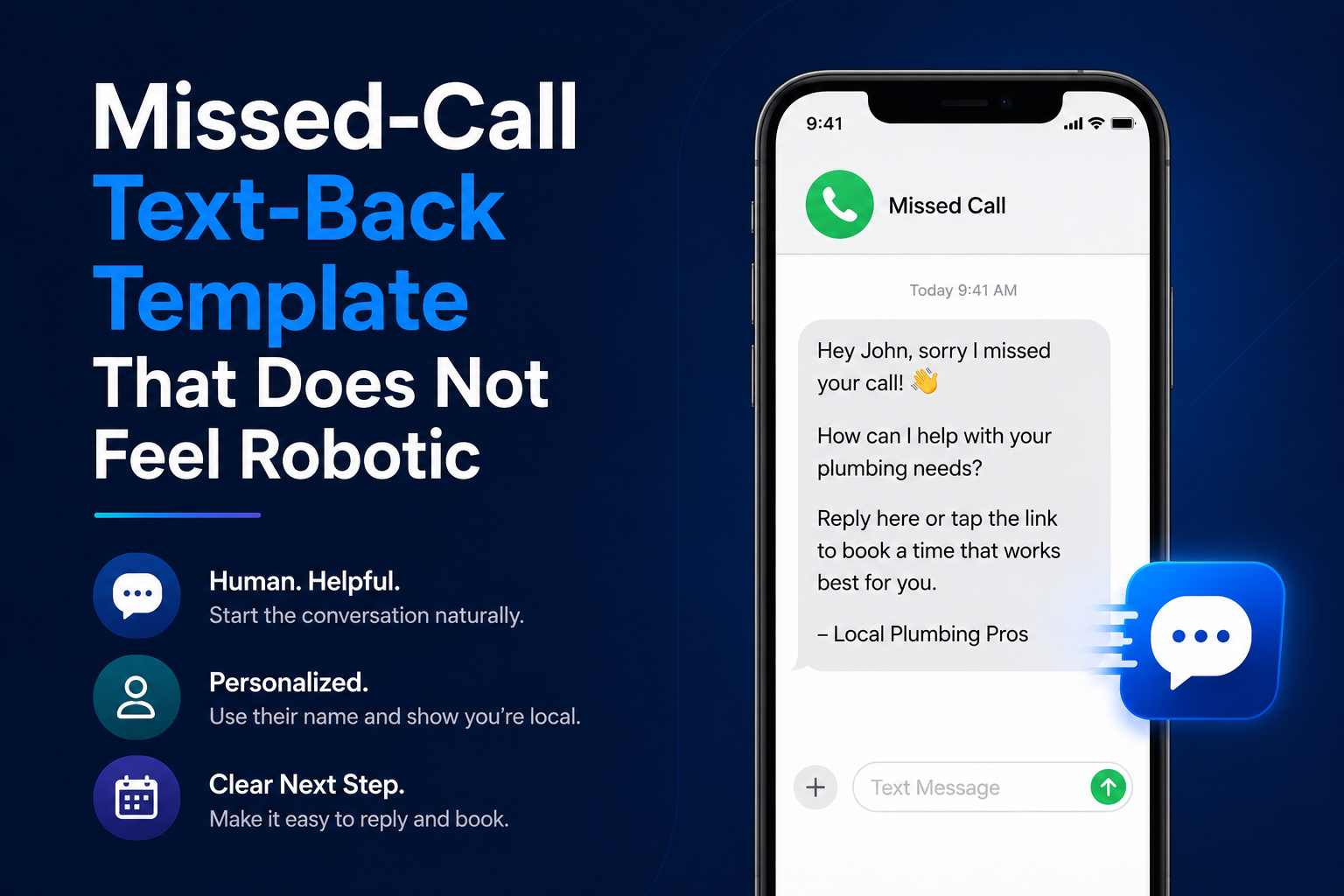
Hi, this is [Business Name]. Sorry we missed your call. What’s going on, and I’ll get right back to you.
Plumbing:
Hi, this is [Business Name]. Sorry we missed you. Is anything actively leaking right now, or can it wait a bit? I’ll text you back in a few minutes either way.
HVAC:
Hi, this is [Business Name]. Sorry we missed your call. Is your AC/heat out completely, or just acting up? I’ll follow up shortly with next steps.
Roofing / electrical:
Hi, this is [Business Name]. Sorry we missed you. Is this storm damage or an ongoing issue? Send me your address if you want, and I’ll get back to you soon.
Notice none of these ask for a name, an email, a preferred appointment time, and a photo all in the first message. Pick the one detail that changes how urgently you respond, ask for that, and stop.
After-Hours / Emergency Variant
After-hours is where text-back earns its keep. The furnace dies on the first cold night, a pipe bursts on a Sunday, and nobody’s in the office to answer. The job isn’t to solve the problem at 11 PM, it’s to make the customer feel heard so they don’t hang up and call the next name on the list.
Hi, this is [Business Name]. We’re closed for the night but saw you called. If this can’t wait (active leak, no heat, no power) reply URGENT and we’ll get back to you tonight. Otherwise I’ll follow up first thing in the morning.
That one line does three things: it’s honest about being closed, it gives a real path for genuine emergencies, and it sets an expectation for everyone else so they’re not left guessing.
What to Ask for Next, and Why One Question at a Time
Once the customer replies, resist the urge to fire off every remaining question in one message. Ask for the next single piece of information you actually need to move forward (service type, a photo, the address, or a time window) then stop and wait.
The reason this matters more than it seems: a text conversation that reads like a form (“Name? Address? Time? Photos?”) feels like you’re processing them. A text conversation that reads like a back-and-forth feels like you’re actually talking to them. Same information, completely different experience, and the second one is the one that turns into a booked job instead of a customer who stops replying halfway through.
When to Get a Human Involved
No template should try to carry a conversation all the way to a booked job on its own. Hand it off to a real person when:
- The customer sounds upset or the situation is clearly urgent
- The request is unusual or doesn’t fit your normal service list
- Pricing or scheduling gets specific enough that a wrong answer would cost you the job
- The exchange has gone back and forth more than two or three times without resolving
A missed-call text’s job is to keep the door open long enough for a person to walk through it, not to replace that person.
Do You Need Software for This, or Can You Do It by Hand?
You don’t need software to write a good missed-call text. You need it to send one fast enough. The template itself works whether you type it manually from your phone the second you see a missed call, or it fires automatically through your phone system.
What actually loses leads is speed: if you’re checking voicemail at the end of the day, the customer has already called someone else. If you can realistically text back within a couple of minutes every time, by hand is fine.
If your call volume makes that unrealistic, that’s when automating the send (not the wording) starts to pay for itself. I’ve written more on the automation side in how to use AI to respond to missed calls if you want to go that route.
Either way, the words matter more than the tool. A perfectly automated system sending a robotic template still feels robotic. A manually typed message using the four-part structure above still feels human.
Frequently Asked Questions
What should a missed-call text back say?
Name your business, admit you missed the call, and ask exactly one question that tells you how urgent the job is. Skip the intake form, one detail is enough to start the conversation.
How fast should the text go out after a missed call?
Within a minute or two if you can manage it. The customer is usually still holding their phone; after five minutes a lot of them have already called the next name on the list, and after an hour most have moved on for good.
Will customers know it's automated, and does that matter?
Some will guess, and that's fine. What actually bothers people isn't knowing it's automated, it's getting a message that reads like a form letter. A short, specific text that sounds like a person wrote it lands fine even if a system sent it.
Do I need special software to send a missed-call text?
No. You can type this by hand from your phone the moment you see a missed call. Software only becomes worth it when your call volume makes it impossible to reply that fast every time.
Is a missed-call text back legal (TCPA)?
Generally, yes. Replying by text to someone who just called you is treated as a service message, not marketing, since they initiated contact. Keep the first message transactional, skip any offers or discounts, and include a way to opt out.
What if the customer's reply doesn't fit the script?
That's normal, and it's exactly when a person should take over. The template's only job is to get the conversation started. Once it's underway, treat it like any other conversation with a customer, not a script to force them back into.
Want more practical breakdowns like this?
If you want more of this kind of practical, no-fluff breakdown, texting, missed calls, voice AI, CRM workflows, review automation, I write about it regularly. Join the newsletter and I'll send the useful stuff straight to your inbox.