Quick Answer
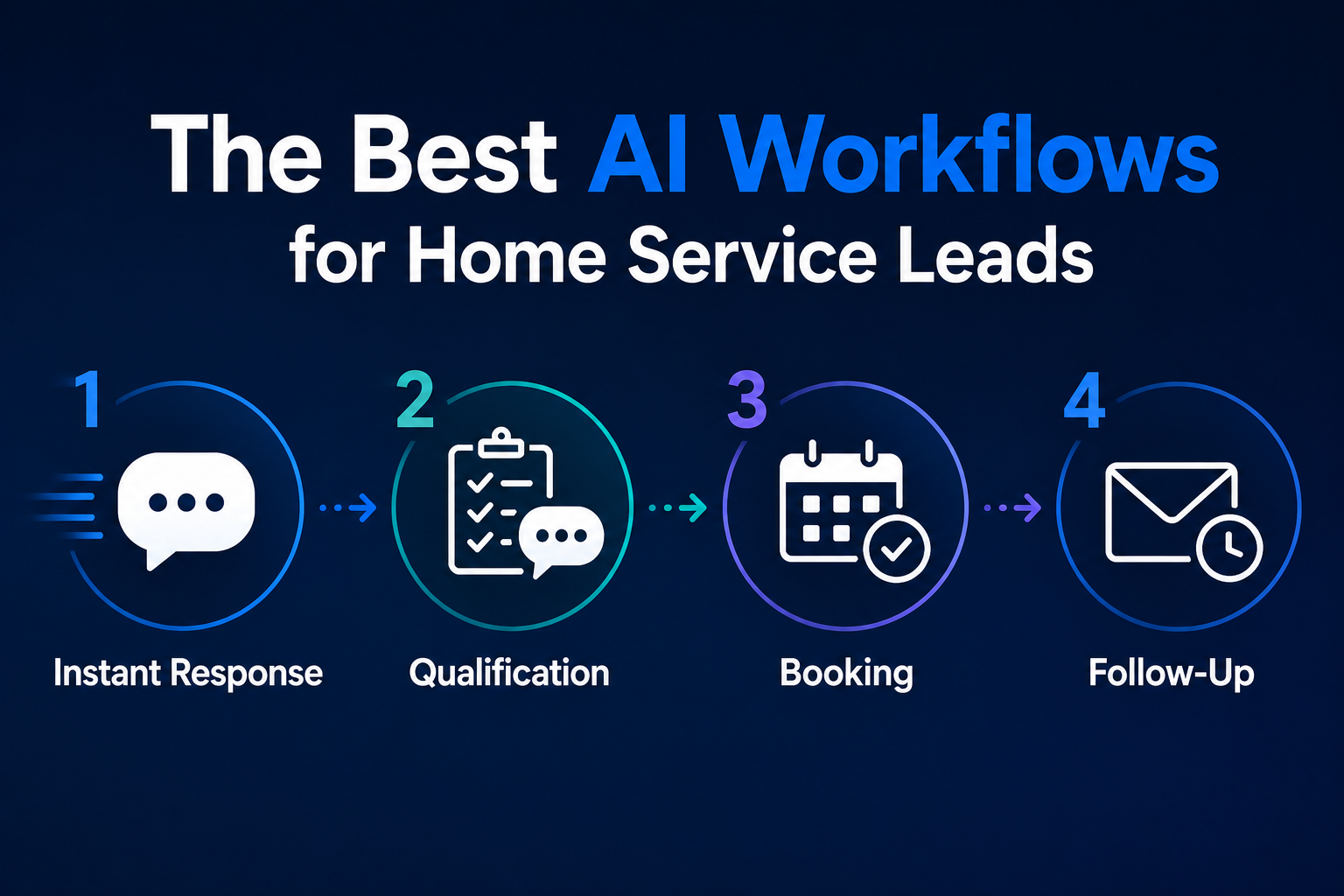
tl;dr: Every lead moves through four moments: instant response, qualification, booking, and follow-up. Treating them as one connected pipeline is what actually recovers revenue, not four separate disconnected tools. If you can only build one thing first, build instant response, then follow-up, since those two pay back fastest and take the least setup.
If you only build four things with AI in your business, build these: a way to respond to every lead instantly, a way to qualify it before you drive out, a way to book it without ten text messages back and forth, and a way to follow up so paid-for leads don’t die quietly in your CRM. That’s the whole system. Everything else is optional.
I’ve watched a lot of home service owners buy AI tools piecemeal, a chatbot here, a texting app there, without ever stepping back to see how the pieces should connect. So let’s walk through the four workflows in order, what “good” looks like at each stage, and which one to build first if you’re starting from zero.
What Are the Four AI Workflows Every Home Service Business Needs?
Every lead that comes into your business (call, form fill, text, whatever) goes through the same four moments: it gets a response, it gets qualified, it gets booked, and (if it doesn’t book right away) it gets followed up on. AI can run any or all of these steps for you. The trick is treating them as one pipeline instead of four separate tools that don’t talk to each other.
Here’s the short version of each, before we go deep:
| Workflow | What it does | Why it matters |
|---|---|---|
| Instant response | Replies to every call, text, or form fill within seconds | Speed is the single biggest lever on whether you get the job at all |
| Qualification | Asks the questions that separate real jobs from tire-kickers | Saves truck rolls and protects your techs’ schedules |
| Booking | Gets the job on the calendar without back-and-forth | Removes friction between “interested” and “confirmed” |
| Follow-up | Keeps unbooked leads warm and turns finished jobs into reviews | Recovers revenue you already paid to generate |
Workflow 1: Instant Response, Stop Losing Leads in the First Five Minutes
Instant response means every incoming lead (a call, a missed call, a web form, a text) gets some kind of reply within seconds to a couple of minutes, not hours. This is the highest-leverage workflow in the whole list, and it’s usually the cheapest to set up.
Why Speed Matters More Than Almost Anything Else
The data on this is not subtle. Leads contacted within five minutes are roughly 21 times more likely to actually engage than leads contacted after 30 minutes, based on a widely-cited Harvard Business Review study of over 2 million sales leads. Text responses sent within 60 seconds book appointments at close to 73%, compared to around 4% when the response comes after 30 minutes.
And here’s the part that should sting a little: the average home service business takes somewhere between 30 minutes and several hours to respond to a new lead, and only a small fraction of contractors consistently respond within five minutes. Meanwhile, 78% of customers go with whichever business responds first, not whichever business is best, cheapest, or most experienced. Just first.
I’ve seen this play out on a Friday at 5:30pm: a water heater dies, the homeowner calls three plumbers off Google, and books with whichever one calls back first, often within the hour. If your phone rang and went to voicemail, you were probably out of the running before you even knew there was a job.
What Instant Response Actually Looks Like
In practice, this workflow covers two situations: someone calls and you can’t pick up, or someone fills out a form/texts and nobody’s watching the inbox. For the missed-call side specifically, I’ve written a full breakdown on how to use AI to respond to missed calls, it’s worth reading if this is the piece you’re missing, since roughly 62% of calls to small businesses go unanswered, and 85% of those callers never call back. A text that goes out within 30-60 seconds of a missed call is often the single highest-ROI automation a home service business can set up.
For web forms and texts, the same principle applies: an AI-driven auto-reply that acknowledges the request and asks one or two quick questions beats a “we’ll get back to you within 24 hours” message every time.
Bottom line: if you build nothing else on this list, build instant response first.
Workflow 2: Qualification, Sort Real Jobs from Tire-Kickers Before You Roll a Truck
Qualification means using a short set of automated questions to figure out whether a lead is a real, bookable job before you spend staff time or a truck roll on it. This usually happens right after the instant response, in the same conversation.
Think about what you actually need to know before you book something: what’s the problem, how urgent is it, what’s the address or service area, and roughly what’s the budget or scope. Most owners ask these questions manually, one lead at a time, which is fine when you get five leads a week and painful when you get fifty.
The Questions Worth Automating
A good AI qualification flow usually asks some version of:
- What’s going on? (problem description)
- Where are you located? (confirms you actually service the area)
- How soon do you need this done? (urgency/emergency flag)
- Is this a repair, replacement, or new install? (rough scope)
- Have you had anyone else out to look at it? (competitive signal)
I’ve seen this cut down on wasted estimate visits significantly. When a “quick AC fix” turns out to be a full system replacement outside a customer’s budget, you’d rather find that out over text than after a tech has already driven 25 minutes each way. These are also the right qualifying questions to automate for your specific trade, since plumbing qualification looks different from roofing qualification, and the details matter more than the concept.
One caution: don’t over-qualify. Five questions is a conversation. Twelve questions is an interrogation, and people abandon it. Keep it to what you genuinely need to decide whether and how to book.
Workflow 3: Booking, Get It on the Calendar Without a Phone Tag Marathon
Booking means the lead can land on your actual calendar, with a confirmed time slot, without a human manually checking availability and going back and forth to schedule it. This is where a lot of the “AI is finally paying for itself” feeling shows up, because booking friction is where warm leads go cold.
Once a lead is qualified, the AI workflow should be able to check tech availability, offer real time slots, and lock in the appointment, synced to whatever you’re already using (Housecall Pro, ServiceTitan, Jobber, etc.) so nothing gets double-booked or lost.
There’s a real decision here: should booking happen over text or over a voice call? I get asked this constantly, and the honest answer is “it depends on the job and the customer,” which is exactly why I wrote a full comparison in SMS vs. AI Answering Service: What Books More Jobs? Short version: SMS tends to win for straightforward, non-emergency bookings people are comfortable scheduling on their own time, while voice AI tends to win for urgent or complex situations where someone wants to talk it through. Most businesses end up needing both.
Whichever channel you use, the core requirement is the same: the appointment has to land in your real scheduling system in real time, not in a spreadsheet someone checks later.
Workflow 4: Follow-Up, The Leads You Already Paid For
Follow-up means automatically re-engaging leads who didn’t book right away, and automatically reaching out to past customers for reviews or repeat work after a job is done. This is the workflow owners skip most often, and it’s leaving real money on the table.
Here’s a number worth sitting with: businesses using automated AI follow-up close 30-40% more of their leads than businesses relying on manual follow-up. A lot of “lost” leads aren’t actually lost. They’re just people who got busy, didn’t answer at the right moment, or wanted to think about it for a day. A follow-up sequence (a text the next day, another a few days later, maybe a check-in a week out) catches a chunk of those people without anyone on your team lifting a finger.
The same logic applies after the job is done. Once a technician closes out a job, an automated text or email asking for a review, timed right after the customer’s had a good experience, turns finished work into online reputation. I’ve written a specific walkthrough on how to automate review requests from Housecall Pro if you’re using that platform, since the setup there is genuinely simple and most businesses aren’t doing it.
What a Good Follow-Up Sequence Looks Like
- Same day, if unbooked: a friendly “still want to get this scheduled?” text
- 2-3 days later: a second touch, maybe with a small incentive or reminder of availability
- After job completion: a review request within a few hours, while the experience is fresh
- 60-90 days later (for maintenance-type trades): a “due for a check-up” nudge
None of this needs to be clever. It needs to be consistent, which is exactly what automation is good at and humans, understandably, are not.
Which Workflow Should You Set Up First?
If you’re starting from nothing, build in this order: instant response, then follow-up, then booking, then qualification. That might surprise you (most people assume booking is the priority), but instant response and follow-up both plug straight into leads you’re already generating, with the least setup complexity. Qualification and booking add more value once you have volume to justify the extra automation, but they matter less if leads are dying before they ever get a first response.
Frequently Asked Questions
Which AI workflow should I set up first if I can only do one?
Instant response, specifically missed-call text-back. It's the cheapest to set up, addresses the single biggest lead-killer (slow response time), and doesn't require rebuilding how you already book or manage jobs.
How much does it cost to set these workflows up?
Most small home service businesses can run a basic instant-response and follow-up setup for somewhere in the $100-$250/month range, with more advanced voice AI or full qualification-and-booking systems running higher depending on call volume. Costs vary a lot by vendor, so it's worth comparing options directly.
Will customers be able to tell they're talking to AI, and will it feel robotic?
Customers often can tell, and that's fine as long as the interaction is fast, clear, and actually helpful. Most people care more about getting a quick, useful response than about who or what sent it. The risk isn't "sounding like AI." It's sounding scripted or ignoring what the customer just said; a well-set-up workflow avoids that by asking real qualifying questions and handing off to a human the moment something gets complicated.
How fast does "instant response" actually need to be?
Aim for under 60 seconds for a missed-call text-back, and no more than a few minutes for form fills or web chats. Response speed has an outsized effect on booking rates: leads contacted within five minutes convert dramatically better than leads contacted even 30 minutes later.
Do I need all four workflows, or can I skip some?
You don't need all four on day one, but each one you skip is leaving some amount of booked revenue on the table. Instant response and follow-up are the two with the fastest payback, so start there before worrying about the other two. Qualification and booking automation become more valuable as your lead volume grows.
How long does it take to get a workflow like this running?
Instant response and basic follow-up sequences can usually be live within a day or two once you pick a tool, since they mostly plug into your existing phone number and CRM. Booking and qualification workflows take a bit longer to configure properly because they need to sync with your actual scheduling system and reflect how your specific trade prices and scopes jobs.
Want a breakdown like this every week?
I send a breakdown like this most weeks: real numbers, real field examples, no hype. join the newsletter and I'll walk you through the next one.